Framing the question
What are we trying to understand?
An initial concern might be whether organisations understand and comply with their building-safety responsibilities.
However, compliance is not simply a matter of knowing what the regulations require: the conditions within which people and organisations operate may also shape their ability to act.
This opens up a broader question: what enables or constrains the behaviours needed to manage building-safety risks effectively?
Seeing the wider context
What conditions shape what happens?
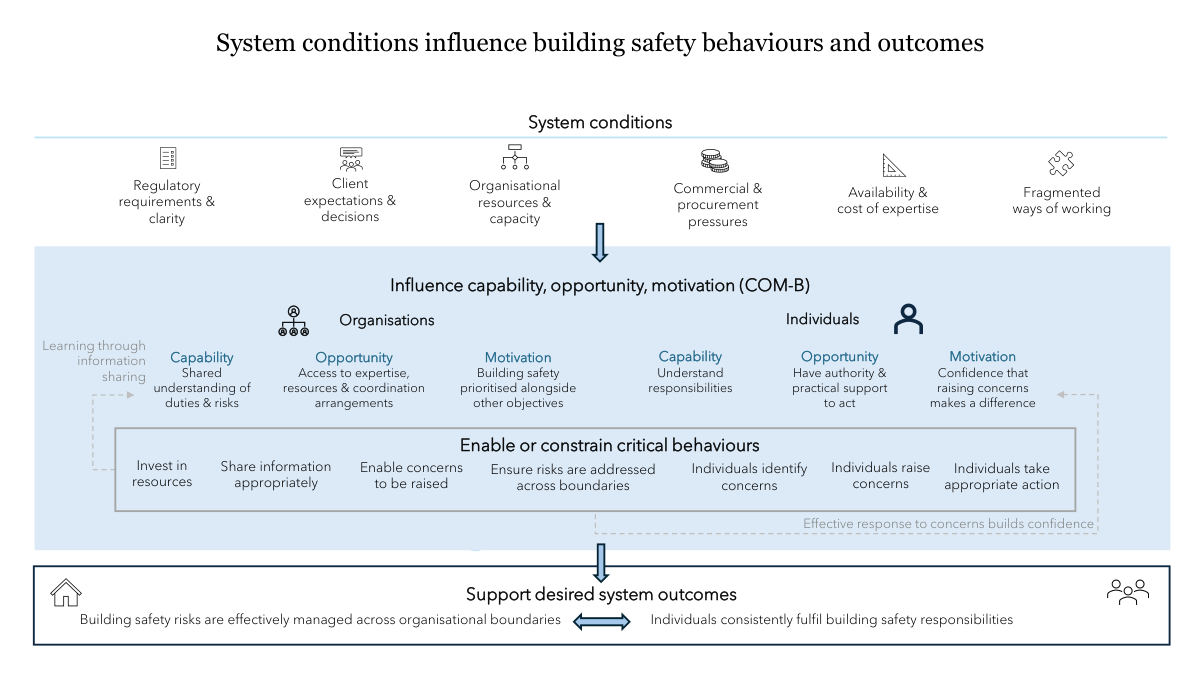
Looking across the published research reveals several potentially important influences: regulatory requirements and clarity, client expectations and decisions, organisational resources, commercial and procurement pressures, access to expertise, and fragmented ways of working.
A conceptual systems and behavioural model brings these together, exploring how wider conditions may influence the capability, opportunity and motivation of organisations and individuals.
These influences can affect whether people have the knowledge, resources, confidence and practical support needed to act — and whether critical behaviours can be carried out across organisational boundaries.
Looking more closely
How do these conditions affect a particular organisation?
Resident Management Companies (RMCs) provide a useful illustration.
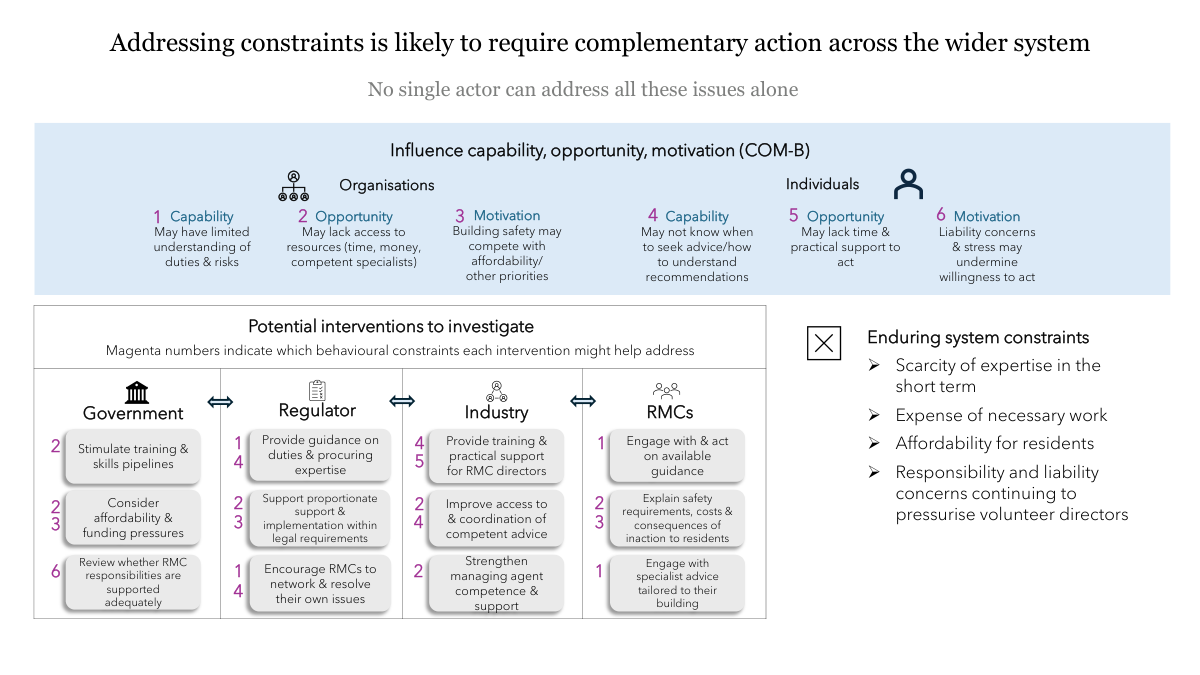
Often run by volunteer directors, RMCs may hold significant responsibilities for managing building safety risks. Yet they may depend on managing agents and external specialists for the expertise required, while facing constrained resources, affordability concerns and personal liability pressures.
Applying the wider system model to this situation suggests a potential mismatch between regulatory responsibility and practical ability.
It also leads to a sharper strategic question: How can organisations fulfil their regulatory responsibilities when some of the conditions needed to act are outside their control?
Exploring possibilities
What might change, who could influence it, and what might remain?
This reframed question directs attention beyond the actions of RMCs alone.
Potential opportunities for investigation include government action on skills and affordability, regulatory guidance and support, industry improvements in access to expertise, and practical steps RMCs could take to obtain advice and communicate with residents.
These are complementary possibilities, rather than a single proposed solution. Each may also have limitations or create new risks that would need to be explored.
Even with coordinated action, some constraints may remain: the scarcity and expense of specialist expertise, the affordability of necessary work for residents, and the responsibility and liability concerns experienced by volunteer directors.